Atlas · Plate V · Scientific Basis
Biochemistry and Nutrition
Biochemistry and nutrition explain how food becomes energy and tissue, and how diet shows up in the mouth. The area covers enzymes and energy metabolism, the macronutrients, vitamins and minerals, the link between sugar and caries, the oral signs of eating disorders, and how to analyze a patient's diet.
The NBDHE tests it in the Scientific Basis section, and the high-yield material is practical. Know that how often sugar is eaten matters more than how much, that sucrose is the most cariogenic sugar, which vitamin deficiencies cause bleeding gingiva, angular cheilitis or glossitis, and what repeated vomiting does to the lingual surfaces of the maxillary anterior teeth. Chairside, all of this becomes diet counseling for caries-prone patients.
Blueprint Scientific Basis for Dental Hygiene Practice · Biochemistry and Nutrition · 44 facts

In this plate, we cover
01 · 5 facts
Biochemistry basics
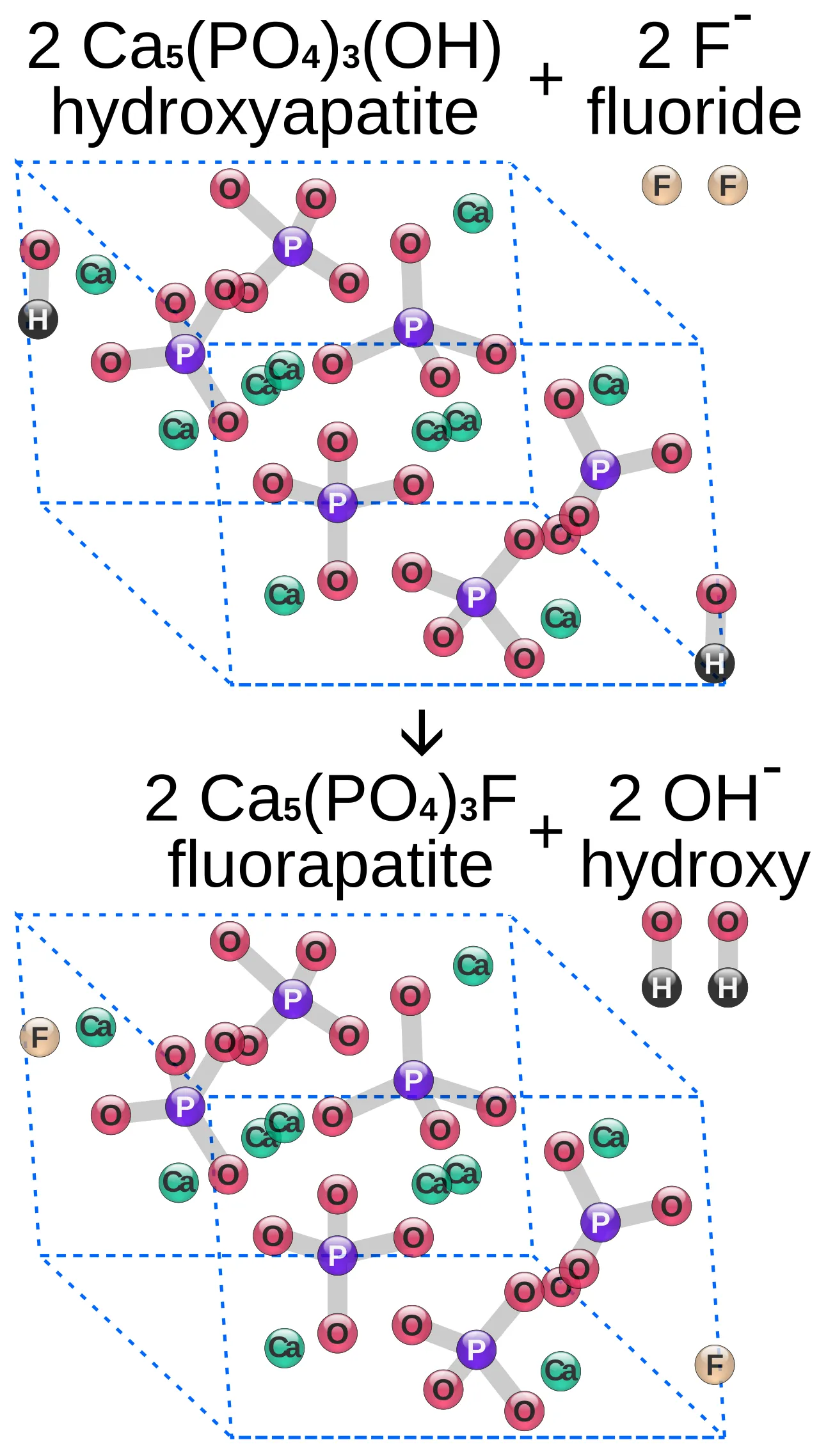
Enzymes are protein catalysts, usually named with an -ase ending. Cells split glucose into pyruvate by glycolysis, and aerobic respiration then yields far more ATP than fermentation. Oral bacteria ferment sugar into lactic acid, which dissolves hydroxyapatite. Fluoride can take the place of its hydroxyl group to form fluorapatite, and type I collagen is the main protein in dentin, cementum, bone and PDL.
- Enzymes are protein catalysts; most are named with the suffix "-ase."S49
- Glycolysis turns glucose into pyruvate; aerobic respiration (Krebs cycle plus electron transport) yields far more ATP than anaerobic fermentation.S49
- Oral bacteria ferment sugars into lactic acid, which demineralizes enamel.S37
- Hydroxyapatite formula: Ca10(PO4)6(OH)2; fluoride replaces hydroxyl to form fluorapatite.S44

02 · 7 facts
Macronutrients
Carbohydrate and protein each supply 4 kcal per gram, fat 9 and alcohol 7. Adults should get 45-65% of calories from carbohydrate, 20-35% from fat and 10-35% from protein, keeping added sugars and saturated fat each under 10%. Nine of the 20 amino acids are essential, and building collagen depends on vitamin C.
- Energy per gram: carbohydrate 4 kcal, protein 4 kcal, fat 9 kcal, alcohol 7 kcal.S54
- Adult acceptable ranges: carbohydrate 45-65% of calories, fat 20-35%, protein 10-35%.S54
- Dietary Guidelines: keep added sugars under 10% of daily calories and saturated fat under 10%; sodium under 2,300 mg/day.S54
- Protein is built from 20 amino acids, 9 of which are essential (must come from food).S49
03 · 12 facts
Vitamins
Vitamins A, D, E and K are fat-soluble and stored, so they can build up to toxic levels; the B vitamins and C dissolve in water and are mostly excreted. Several deficiencies show in the mouth: low vitamin C causes swollen, bleeding gingiva, riboflavin deficiency causes angular cheilitis, niacin and B12 deficiencies cause glossitis, and low vitamin K causes bleeding.
- Fat-soluble vitamins are A, D, E and K; they are stored in the body and can build up to toxic levels.S53
- Water-soluble vitamins are the B group and C; excess is mostly excreted in urine.S53
- Vitamin C RDA: 90 mg/day for adult men, 75 mg/day for women; smokers need 35 mg/day more.S53
- Vitamin C deficiency (scurvy) causes swollen, bleeding gingiva and poor wound healing.S53
04 · 7 facts
Minerals
Calcium and phosphorus build hydroxyapatite, and about 99% of the body's calcium is in bones and teeth. Most adults need 1,000 mg of calcium a day. Iron deficiency anemia can cause pallor, glossitis and angular cheilitis, zinc deficiency dulls taste and slows healing, and adult fluoride intake should stay below the 10 mg daily upper limit.
- Calcium RDA: 1,000 mg/day for most adults; 1,200 mg/day for women over 50 and men over 70.S53
- About 99% of body calcium is in bones and teeth.S53
- Iron RDA: 8 mg/day for adult men and postmenopausal women; 18 mg/day for women 19-50; 27 mg in pregnancy.S53
- Iron deficiency anemia can cause pallor, glossitis and angular cheilitis; Plummer-Vinson syndrome adds dysphagia.S53T5
05 · 9 facts
Diet and caries
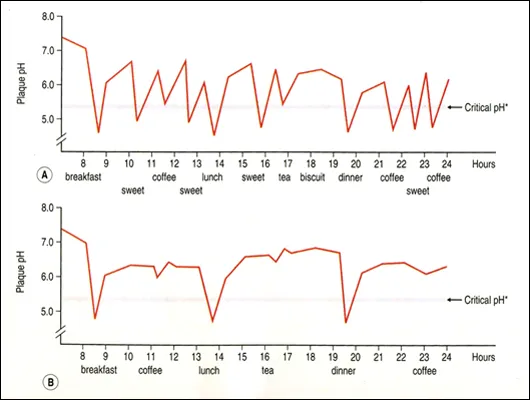
Caries needs a susceptible tooth, cariogenic bacteria, fermentable carbohydrate and time together. After each sugar exposure, plaque pH drops below the critical level of about 5.5 for enamel within minutes and takes 20-40 minutes to recover, so frequent snacking and sipping do more harm than the total amount. Xylitol, cheese and milk help, and a 3-7 day diet diary guides counseling.
- Caries needs four things together: a susceptible tooth, cariogenic bacteria, fermentable carbohydrate and time.S37
- The Stephan curve: plaque pH drops below the critical level within minutes of a sugar exposure and takes about 20-40 minutes to recover.S48
- Critical pH for enamel is about 5.5; for root dentin and cementum it is higher, about 6.0-6.7.S37S48
- Frequency and retention of sugar intake matter more than the total amount.S48
06 · 4 facts
Eating disorders
Bulimia nervosa cycles between bingeing and purging. Repeated vomiting erodes the lingual surfaces of the maxillary anterior teeth (perimylolysis), usually after about six months, and can enlarge the parotid glands and callus the knuckles. Anorexia nervosa brings dry mouth and severe weight loss. Advise rinsing with water or a baking soda solution after vomiting and waiting 30-60 minutes to brush.
- Bulimia nervosa: binge-purge cycles; signs include lingual erosion of maxillary anterior teeth (perimylolysis), parotid enlargement and calloused knuckles (Russell sign).T5
- Anorexia nervosa: severe restriction; signs include dry mouth, low body weight, lanugo and possible erosion if purging.T5
- Erosion from vomiting usually appears after about 6 months of regular purging.T5
- Advise rinsing with water or a sodium bicarbonate solution after vomiting and delaying brushing for about 30-60 minutes.T2
Watch